Don't Wait to Feel Motivated: How to Train Your Brain to Take Action
By Dr. Ali Araghi · October 16, 2026 · 10 minute read
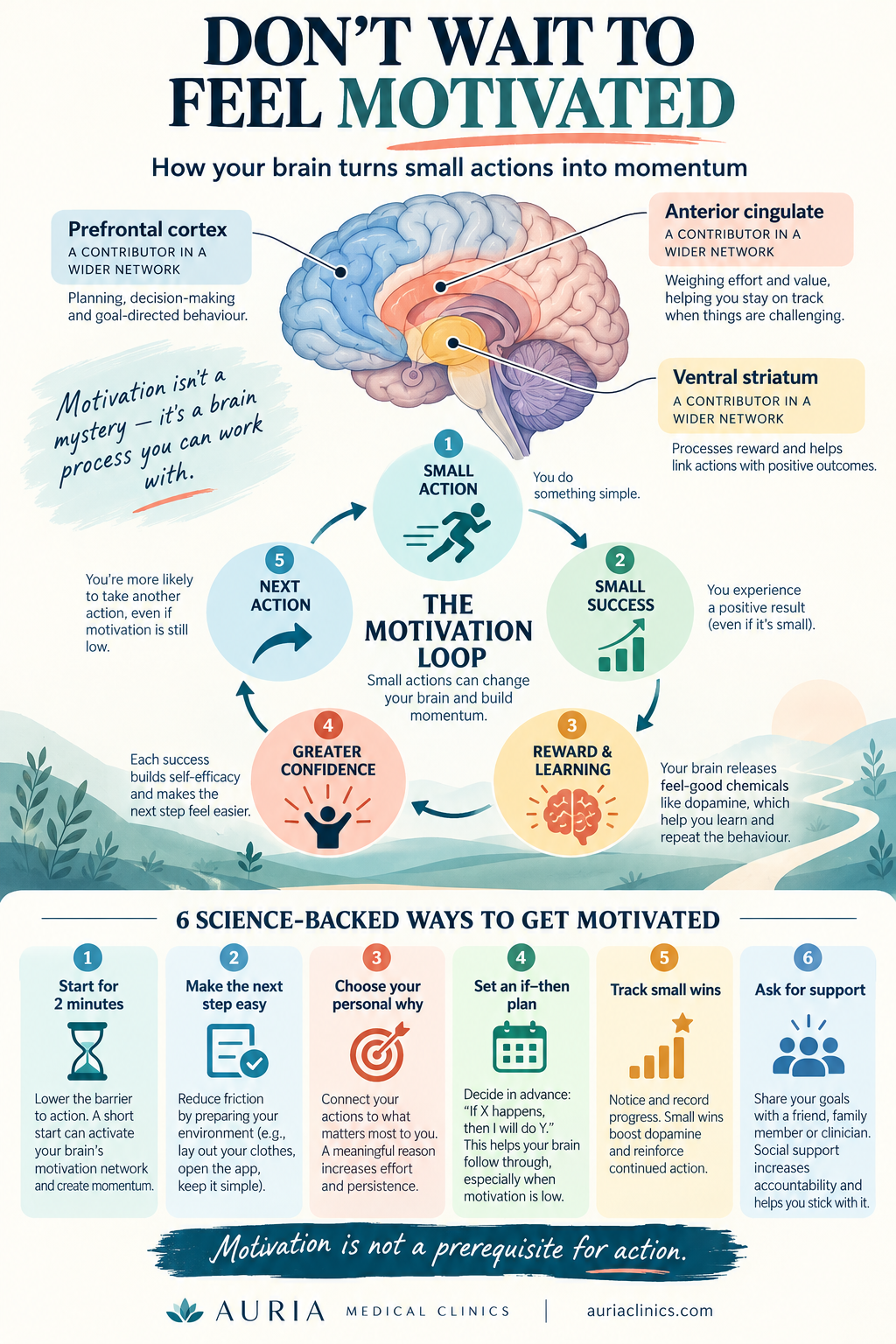
The neuroscience of motivation - and why small actions may be the secret to lasting change.
Auria Medical Clinics | Patient Education & Wellness
The Monday Morning Promise
It is Sunday night. You make a promise to yourself.
"Tomorrow, I'm going to start exercising. I'm going to eat better. I'm going to take control of my health."
You feel determined. You can almost picture the healthier, more energetic version of yourself.
Then Monday morning arrives.
The alarm rings. You're tired. Your schedule is crowded. Exercise suddenly feels exhausting. By lunchtime, you've replaced the healthy meal you planned with your usual fast food.
You tell yourself, "I just don't have enough motivation."
But what if motivation is not simply a matter of willpower? What if your brain is making a complicated calculation about effort, reward, energy, and uncertainty?
The good news is you can learn to work with these brain processes instead of constantly fighting them.
1. What Is Motivation, Really?
Motivation is a set of biological and psychological processes that direct our behavior toward what we want - or away from what we fear.
Your brain is continuously evaluating questions such as:
-
Is this worth doing?
-
How much effort will it require?
-
How soon will I see a reward?
-
Do I believe I can succeed?
-
Is there something easier or more enjoyable I could do instead?
These calculations often occur automatically, without conscious awareness.
Consider a person who wants to lose weight. The long-term rewards are meaningful: better mobility, improved blood pressure, better glucose control, and perhaps better sleep.
But the immediate alternatives - watching television instead of exercising or ordering fast food instead of preparing dinner - often require less effort and provide faster gratification.
The challenge is not simply knowing what is healthy. It is helping the brain choose a worthwhile long-term goal over an attractive immediate alternative.
2. Meet the Brain's Motivation Network
There is no single "motivation center" in the brain. Motivation emerges from the interaction of multiple neural networks.
Dopamine: More Than the Pleasure Chemical
Dopamine is frequently described as the brain's pleasure chemical. That description is incomplete.
Dopamine supports learning, reward prediction, willingness to exert effort, and selecting goal-directed behaviors.
Imagine walking past your favorite bakery.
The smell of freshly baked bread may trigger anticipation before you taste anything. Your brain has learned that this experience predicts something rewarding.
Dopamine-related signaling helps shape that anticipation and future behavior.
Now compare that with a recommendation to walk for 30 minutes every day. The health benefits may be substantial, but they come later and are less noticeable at first.
Your brain may therefore assign greater immediate motivational value to the bakery than to the walk.
The solution is not necessarily to increase dopamine. Instead, make healthy behavior easier, more rewarding, and more personally meaningful.
The Prefrontal Cortex: Your Long-Term Planner
The prefrontal cortex supports planning, decision-making, working memory, and goal-directed behavior.
It helps you consider future consequences and resist immediate distractions.
When you choose to prepare a healthy dinner instead of ordering takeout, prefrontal networks help you maintain that intention.
However, executive control can become harder when you're sleep-deprived, stressed, distracted, or overwhelmed.
That is why an elaborate exercise program may seem reasonable on Sunday evening but nearly impossible after an exhausting Monday.
The Ventral Striatum: Learning What Is Worth Doing
The ventral striatum, including the nucleus accumbens, contributes to reward-related learning and motivated behavior.
When an action yields a positive result, this system helps update the value you assign to similar actions in the future.
A pleasant walk, a satisfying healthy meal, or a sense of accomplishment after completing a task can make repeating that behavior more appealing.
The Anterior Cingulate Cortex: Is the Effort Worth It?
The anterior cingulate cortex helps evaluate effort, conflict, and an action's potential value.
It is part of a broader network that helps you decide whether a reward justifies the work required.
If going to the gym involves changing clothes, driving 20 minutes, finding parking, and completing a difficult workout, the perceived effort may outweigh the anticipated reward.
But walking outside your home for five minutes may feel manageable.
Sometimes the best way to increase action is simply to reduce the effort required to begin.
3. The Motivation Paradox: Action Often Comes First
Most of us imagine behavior change following this sequence:
Motivation → Action → Results
But a different sequence can also occur:
Small Action → Positive Experience → Increased Confidence → Greater Willingness to Act Again
This is one of behavioral psychology's most useful lessons.
For example, suppose you feel completely unmotivated to exercise.
Instead of waiting for inspiration, you put on your walking shoes and go outside for five minutes.
You might notice that the walk is more pleasant than you expected. Perhaps your mood improves slightly, or you feel satisfied that you followed through.
That experience can influence your expectations the next time.
With repeated practice, healthy behavior may become easier to start.
This principle is related to behavioral activation, a structured psychological treatment that encourages meaningful activities even when a person initially lacks motivation.
Importantly, researchers are still investigating the precise neural mechanisms behind behavioral activation's benefits. It is not simply a matter of triggering a dopamine release.
The practical lesson remains powerful:
You do not always need to feel motivated before taking the first step.
4. Why Motivation Disappears
Motivation naturally fluctuates. Some days we feel energetic, confident, and optimistic. Other days, even simple tasks seem unusually difficult.
Several factors influence this process.
Delayed rewards: Healthy behaviors often require immediate effort, but the benefits may take weeks or months to become noticeable.
High activation energy: Complex tasks require more planning, preparation, and mental effort.
Fear of failure: Previous unsuccessful attempts may reduce confidence and make the brain anticipate disappointment.
Stress and poor sleep: These can interfere with attention, emotional regulation, and decision-making.
Lack of personal meaning: Goals imposed by others may feel less compelling than goals connected to your own values.
Medical and psychological conditions: Depression, ADHD, sleep disorders, certain medications, chronic pain, and other health problems can make initiating activities especially difficult.
Don't automatically label persistent loss of motivation as laziness or poor discipline. Sometimes it deserves medical evaluation.
5. Six Neuroscience-Informed Ways to Become More Motivated
Strategy 1: Use the Two-Minute Rule
When a task feels overwhelming, make the first step so small that it becomes easy to start.
Instead of "I must exercise for 45 minutes," try "I will walk for two minutes."
Instead of "I have to change my entire diet," try "I will add vegetables to one meal."
Two minutes is not a scientifically established magic threshold. It is a practical way to lower the barrier to starting.
Once you begin, continuing may feel easier. Even if you stop after two minutes, you have practiced initiating the behavior.
Strategy 2: Make the Healthy Choice Easier
Your environment can influence your behavior as much as your intentions.
Want to walk every morning? Place your walking shoes next to the bed.
Want to eat more nutritious meals? Prepare some ingredients in advance.
Want to take medications consistently? Use an appropriate medication organizer or reminder system.
Reducing friction makes the desired action require less planning and effort.
Strategy 3: Connect the Goal to Your Personal Values
Ask yourself why the behavior truly matters.
Instead of saying, "I need to lose 20 pounds," consider:
"I want to have enough energy to play with my grandchildren."
Instead of "My doctor told me to exercise," try:
"I want to remain independent and active as I get older."
Research on Self-Determination Theory suggests that motivation depends on three key psychological needs: autonomy, competence, and connection with others.
Goals that feel personally chosen and meaningful may be easier to sustain than goals driven primarily by guilt or pressure.
Strategy 4: Create an If–Then Plan
Vague intentions are difficult to execute.
Replace "I'll exercise more" with a specific plan:
"If I finish breakfast, then I will walk for ten minutes."
Or:
"If I feel tempted to order fast food after work, then I will first check the healthy meal I prepared."
These are called implementation intentions.
They connect a specific situation with a planned response, reducing the need to make a new decision every time.
Strategy 5: Celebrate and Track Small Victories
Do not wait until you lose 20 pounds or complete a month of workouts to acknowledge progress.
Notice and record smaller accomplishments:
-
Walking for five minutes
-
Choosing water instead of soda
-
Completing a planned meal
-
Following your medication schedule
-
Returning to your routine after missing a day
Tracking progress provides feedback, while recognizing success can build perceived competence.
The purpose is not to chase a dopamine high. It is to make your progress visible and strengthen confidence in your ability to act.
Strategy 6: Use Social Connection and Accountability
Motivation does not develop in isolation.
Walking with a friend, sharing goals with a family member, participating in a supportive group, or discussing progress with your healthcare professional can make behavior change more manageable.
A supportive relationship can encourage you when motivation is low and help keep the goal personally meaningful.
The goal is collaboration, not criticism.
6. The Seven-Day Motivation Experiment
You do not need to transform your life in one week.
Instead, treat the next seven days as a small experiment in how your brain responds to action.
Day 1: Choose one meaningful health goal and write down why it matters.
Day 2: Reduce the goal to an action you can complete in two minutes.
Day 3: Change your environment to make that action easier.
Day 4: Create an if–then plan identifying exactly when you will act.
Day 5: Complete your small action and record how you felt afterward.
Day 6: Tell someone supportive about your progress.
Day 7: Review what worked, identify barriers, and decide on one realistic adjustment for next week.
You do not need seven perfect days. Missing one day does not erase what you have learned.
The objective is to build a sustainable relationship with the behavior, not to achieve perfection.
7. When Low Motivation May Be a Medical Concern
Occasional lack of motivation is normal.
But persistent loss of interest, severe fatigue, difficulty initiating routine activities, or significant changes in mood and functioning deserve attention.
Potential contributing factors include depression, sleep apnea, insomnia, medication effects, chronic illness, and attention-related disorders.
If low motivation persists, particularly when accompanied by loss of pleasure, hopelessness, significant sleep changes, or inability to manage daily responsibilities, speak with a healthcare professional.
Behavioral strategies can be helpful, but they are not a substitute for diagnosing and treating an underlying condition.
8. Final Thought: You Do Not Need to Become a Different Person Tomorrow
Imagine two people standing at the beginning of a long staircase.
The first person stares toward the top and thinks, "I cannot possibly climb all those stairs."
The second person looks at the first step and says, "I can manage that."
Both face the same staircase. The difference is where they direct their attention.
When it comes to improving your health, you do not have to solve every problem today.
You do not need perfect discipline, unlimited willpower, or a sudden burst of inspiration.
You need a meaningful reason, a manageable first step, and an environment that makes repeating that step easier.
The next time you tell yourself, "I'll start when I feel motivated," try asking a different question:
"What is the smallest useful action I can take right now?"
That action may be the beginning of your motivation - not the result of it.
Your Health Journey at Auria Medical Clinics
At Auria Medical Clinics, we believe sustainable health improvements require more than simply telling patients what to do. Understanding behavior's biology, identifying personal barriers, and creating realistic strategies are essential to long-term change.
Whether your goals involve weight management, better sleep, improved physical activity, or managing chronic disease, our team can help you identify practical next steps.
Visit www.auriaclinics.com to learn more about our services.
For additional support building healthier eating habits, explore EasyWeightManagement.com, including resources that help you translate knowledge into sustainable behavior.
Medical disclaimer: This article is intended for general education and does not replace individualized medical advice or mental health evaluation.
Scientific References
-
Salamone JD, Correa M. The neurobiology of activational aspects of motivation: Exertion of effort, effort-based decision making, and the role of dopamine. Annual Review of Psychology. 2024;75:1–32. https://doi.org/10.1146/annurev-psych-020223-012208
-
Gillison FB, et al. A meta-analysis of techniques to promote motivation for health behavior change from a self-determination theory perspective. Health Psychology Review. 2019;13(1):110–130. https://doi.org/10.1080/17437199.2018.1534071
-
Ng JYY, et al. Self-determination theory applied to health contexts: A meta-analysis. Perspectives on Psychological Science. 2012;7(4):325–340. https://doi.org/10.1177/1745691612447309
-
Mazzucchelli TG, Kane RT, Rees CS. Behavioral activation interventions for well-being: A meta-analysis. Journal of Positive Psychology. 2010;5(2):105–121. https://doi.org/10.1080/17439760903569154
-
Gollwitzer PM. Implementation intentions: Strong effects of simple plans. American Psychologist. 1999;54(7):493–503. https://doi.org/10.1037/0003-066X.54.7.493