Sleep Apnea in 2026: Can Weight-Loss Medications Replace CPAP?
By Dr. Ali Araghi · October 9, 2026 · 10 minute read
By Ali Araghi, MD
Board-Certified in Internal Medicine, Pulmonary Medicine, Critical Care Medicine, Sleep Medicine, and Obesity Medicine
Auria Medical Clinics | October 2026
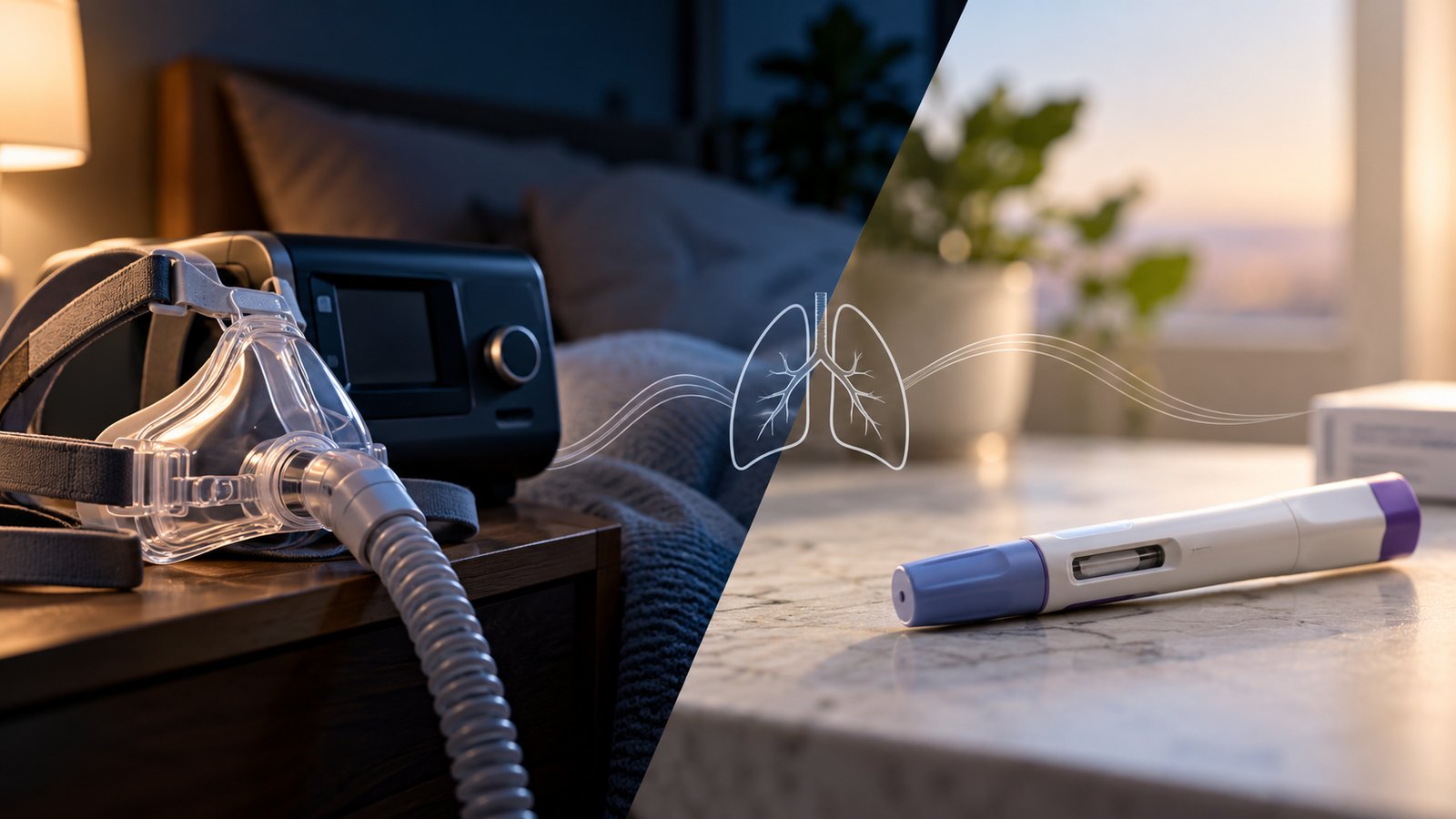
Imagine treating sleep apnea with a weekly injection instead of wearing a CPAP mask every night. Is that finally possible?
For millions of people with obstructive sleep apnea (OSA), continuous positive airway pressure (CPAP) has been a highly effectiv, but sometimes inconvenient, part of their nightly routine.
Now, a new generation of medications is challenging how we think about treating this common sleep disorder.
In December 2024, the FDA approved Zepbound (tirzepatide) as the first medication specifically indicated for moderate-to-severe obstructive sleep apnea in adults with obesity.
Clinical trials demonstrated substantial reductions in breathing interruptions during sleep, along with meaningful weight loss.
Does this mean patients can finally throw away their CPAP machines?
Not so fast.
The science reveals a more interesting story about obesity, upper-airway anatomy, and why treating the underlying causes of sleep apnea may be just as important as keeping the airway open.
Why It Matters
The big picture: Sleep apnea is not simply a snoring problem. It is a disorder of repeated upper-airway collapse that can disrupt sleep, reduce blood oxygen levels, and contribute to cardiovascular and metabolic complications.
Until recently, the primary treatments focused on mechanically preventing airway obstruction.
Now, medications targeting obesity have introduced another therapeutic approach.
Three important facts:
-
A milestone: In December 2024, the FDA approved tirzepatide (Zepbound) for moderate-to-severe OSA in adults with obesity, alongside dietary modification and physical activity.
-
The evidence: In the landmark SURMOUNT-OSA trials, tirzepatide reduced the apnea-hypopnea index (AHI) by approximately 25–29 events per hour over 52 weeks, compared with about 5–6 events per hour with placebo.
-
The limitation: A substantial improvement in sleep apnea does not necessarily mean the condition has disappeared.
The bottom line: Weight-loss medications represent an important advance in treating obesity-related sleep apnea, but they do not automatically replace CPAP.
The Deep Dive
1. Why Does Sleep Apnea Happen?
The key: Sleep apnea is fundamentally a problem of upper-airway collapsibility during sleep.
When we fall asleep, the muscles supporting the tongue and throat relax. In susceptible individuals, the upper airway becomes too narrow or collapses completely.
Breathing stops or becomes shallow until the brain responds, often producing a brief arousal that restores airflow.
These events may recur dozens of times every hour.
The severity is commonly measured by the apnea-hypopnea index (AHI):
SeverityBreathing events per hourNormalFewer than 5Mild OSA5–14.9Moderate OSA15–29.9Severe OSA30 or more
These thresholds are interpreted together with symptoms and clinical findings.
Sleep apnea involves more than anatomical narrowing. Several physiological factors can contribute:
-
Upper-airway anatomy: A narrow or crowded airway is more vulnerable to collapse.
-
Muscle responsiveness: Throat muscles may not respond sufficiently to airway narrowing.
-
Ventilatory control instability: Some individuals have overly sensitive breathing-control systems.
-
Arousal threshold: Some wake too readily to relatively minor breathing disturbances.
These mechanisms are sometimes called the endotypes of obstructive sleep apnea.
Clinical pearl: Two patients with identical AHI scores may have different underlying physiological mechanisms. That is one reason the same treatment does not work equally well for everyone.
2. How Does Obesity Make Sleep Apnea Worse?
The surprising truth: Excess body fat affects breathing through several mechanisms - not simply by adding weight around the neck.
Fat accumulation around the tongue and upper airway can increase its tendency to narrow during sleep.
Abdominal and chest wall fat may reduce lung volume, decreasing the mechanical forces that help keep the upper airway open.
Obesity can also interact with inflammation, metabolic dysfunction, and ventilatory control.
As a result, weight reduction can improve the mechanical conditions that contribute to airway collapse.
However, not everyone with sleep apnea has obesity, and not everyone with obesity has sleep apnea.
Genetics, craniofacial anatomy, age, upper-airway muscle function, and other physiological factors also matter.
Therefore, losing weight does not guarantee that sleep apnea will resolve.
3. How Do Weight-Loss Medications Improve Sleep Apnea?
The breakthrough: Rather than mechanically splinting the airway open, tirzepatide treats obesity, an important contributor to OSA.
Tirzepatide acts on two hormone receptors: GLP-1 and GIP.
These actions influence appetite regulation, food intake, and body weight.
As patients lose weight, several beneficial changes may occur:
-
Reduced fat accumulation around the upper airway and tongue
-
Improved respiratory mechanics and lung volumes
-
Reduced mechanical loading of the chest and abdomen
-
Improvement in some cardiometabolic risk factors
The result may be less upper-airway obstruction during sleep.
Importantly, the strongest established evidence supports improvement associated with substantial weight loss. Whether tirzepatide produces additional direct effects on sleep-apnea physiology beyond weight reduction remains an area of investigation.
The distinction: CPAP works immediately while it is being used. Tirzepatide generally produces improvements progressively as weight loss develops over months.
4. What Did the SURMOUNT-OSA Clinical Trials Show?
The evidence is impressive - but deserves careful interpretation.
Published in the New England Journal of Medicine in 2024, the SURMOUNT-OSA program included two randomized clinical trials involving 469 adults with moderate to severe obstructive sleep apnea and obesity.
The investigators studied two populations:
-
Trial 1: Patients who were not using positive airway pressure therapy.
-
Trial 2: Patients already using positive airway pressure therapy.
Participants received weekly tirzepatide or placebo for 52 weeks.
The primary outcome was the change in AHI.
Outcome after 52 weeksTirzepatidePlaceboAHI reduction, Trial 125.3 events/hour5.3 events/hourAHI reduction, Trial 229.3 events/hour5.5 events/hourWeight reduction, Trial 117.7%1.6%Weight reduction, Trial 219.6%2.3%
Results use the treatment-regimen estimates reported in the primary publication.
Tirzepatide also improved sleep-apnea-related hypoxic burden, blood pressure, and patient-reported sleep-related outcomes.
But here is the crucial point: A patient whose AHI decreases from 50 to 20 events per hour has achieved a substantial improvement - yet still has moderate sleep apnea.
The study demonstrated that tirzepatide can significantly reduce OSA severity. It did not establish that medication is equivalent or superior to CPAP, or that all patients can discontinue positive airway pressure.
5. Medication vs. CPAP: Which Is Better?
The answer depends on what we are trying to treat.
CPAP and tirzepatide work through fundamentally different mechanisms.
FeatureCPAPTirzepatide (Zepbound)MechanismPneumatically splints the upper airway openReduces weight and obesity-related OSA severityOnsetEffective immediately during useGradual improvement over monthsEffect on weightNo direct weight-loss effectSubstantial weight loss in many patientsEffect on OSAOften normalizes breathing when appropriately usedReduces OSA severity; may not eliminate itMain limitationsMask discomfort, leaks, adherenceSide effects, cost, eligibility, long-term treatment needsLong-term approachUse during sleep while treatment is indicatedOngoing individualized obesity management
CPAP remains an established and highly effective treatment for OSA, especially when reliable control of breathing events is needed.
Tirzepatide offers an additional approach for selected patients with obesity and moderate-to-severe OSA.
A key distinction: A medication that reduces AHI by 50% is not necessarily more effective than CPAP, which may control nearly all obstructive events when properly used.
Furthermore, no definitive large head-to-head trial has established that tirzepatide can replace CPAP for every eligible patient.
6. Can You Stop CPAP After Losing Weight?
Possibly - but never based on weight loss or feeling better alone.
Consider a patient with severe OSA who loses 20% of their body weight after treatment with tirzepatide.
They now sleep more comfortably, snore less, and feel more energetic.
Does that mean their sleep apnea has resolved?
Not necessarily.
Symptoms alone cannot reliably determine whether nighttime airway obstruction and oxygen desaturation have normalized.
The American Academy of Sleep Medicine recommends considering follow-up sleep testing when clinically significant weight changes occur, commonly around 10–20% of body weight.
A supervised reassessment may include a home sleep apnea test or in-laboratory polysomnography, depending on the patient's medical conditions and clinical circumstances.
At Auria Medical Clinics, we emphasize three steps:
-
Reassess symptoms, weight change, CPAP use, and cardiometabolic health.
-
Perform appropriate repeat sleep testing when the result would influence treatment decisions.
-
Adjust or discontinue CPAP only after reviewing objective evidence and discussing the risks and benefits.
For patients with residual OSA, continued CPAP, an oral appliance, or another treatment may still be necessary.
Clinical pearl: Losing 40 pounds is a weight-management result. Normalizing the AHI is a sleep-medicine result. They are related, but they are not interchangeable.
7. Who Might Benefit from Tirzepatide?
The opportunity: Patients with both obesity and moderate-to-severe OSA may benefit from a treatment strategy addressing both conditions.
Potential candidates include adults with:
-
Documented moderate-to-severe obstructive sleep apnea and obesity
-
An appropriate clinical indication for tirzepatide
-
Weight-related metabolic complications
-
Difficulty tolerating CPAP, or a need for additional obesity treatment despite CPAP use
-
Willingness to participate in long-term nutrition, activity, and follow-up programs
Not every patient is an appropriate candidate.
Common side effects include nausea, vomiting, diarrhea, and constipation. More serious risks and precautions include pancreatitis, gallbladder disease, severe gastrointestinal adverse reactions, and dehydration-related kidney injury.
Tirzepatide is contraindicated in patients with a personal or family history of medullary thyroid carcinoma or multiple endocrine neoplasia syndrome type 2, as well as those with known serious hypersensitivity to the medication.
Eligibility and treatment decisions should be determined through an individualized medical evaluation.
A practical consideration: Insurance coverage varies, and patients should verify coverage before starting treatment.
8. Why Long-Term Behavior Change Still Matters
The missing ingredient: Medication may make weight loss easier, but maintaining the benefits requires ongoing attention to health behaviors and, for many patients, continued medical treatment.
Sleep apnea and obesity often interact in a cycle.
Poor sleep can contribute to fatigue, reduced physical activity, and changes in appetite regulation. Excess weight can worsen sleep apnea, creating further sleep disruption.
Improving either condition may help make the other more manageable.
This is where long-term habits become especially important.
Regular physical activity, balanced nutrition, sufficient sleep opportunity, consistent treatment use, and recognizing eating triggers can support sustainable improvements.
But knowing what to do does not automatically mean we will do it.
Why do we repeatedly struggle to follow healthy habits - even when we understand their importance?
This question is explored in my book:
FROM KNOWING TO BEHAVING: How Understanding the Science of Habits Can Help You Lose and Maintain a Healthy Weight
The book examines how neuroscience, motivation, reward, and habitual behavior influence our daily decisions - and how we can move from simply knowing what is healthy to consistently practicing it.
For patients managing obesity and sleep apnea, these principles can complement medical treatment.
Interested in learning more?
📖 Get From Knowing to Behaving on Amazon Kindle
9. The Future: Treating the Patient, Not Just the AHI
Sleep medicine is moving toward a more personalized approach.
Instead of treating every patient identically, the future may involve identifying the physiological mechanisms that drive each person's sleep apnea.
Some patients may need CPAP to control airway collapse.
Others may benefit from weight-loss medications, oral appliances, positional therapy, or selected surgical interventions.
Many will benefit from a combination of approaches.
The future of sleep apnea care is not necessarily medication versus CPAP. It is choosing the right treatment, or combination of treatments, for the right patient.
The Pearl
CPAP keeps the airway open. Weight-loss medication can reduce the burden of obesity on the airway. Behavior change supports long-term weight management.
The best treatment is not always one or the other.
It is an individualized strategy that improves sleep, breathing, metabolic health, and quality of life.
And remember: Never discontinue CPAP simply because you have lost weight. Reassess your sleep apnea first.
About Auria Medical Clinics
At Auria Medical Clinics, we understand that obesity and obstructive sleep apnea are often interconnected chronic conditions.
Our integrated approach combines expertise in Sleep Medicine, Pulmonary Medicine, Internal Medicine, and Obesity Medicine.
Our services include:
-
Sleep apnea evaluation and appropriate home sleep apnea testing
-
CPAP treatment and follow-up
-
Medically supervised weight management
-
Individualized assessment of GLP-1/GIP-based treatment options
-
Long-term monitoring of sleep and metabolic health
Are you using CPAP and wondering whether weight-loss medication could improve your sleep apnea?
Schedule an evaluation with our medical team to discuss your options.
Auria Medical Clinics - Suwanee, Georgia.
References and Further Reading
-
Malhotra A, et al. Tirzepatide for the Treatment of Obstructive Sleep Apnea and Obesity. N Engl J Med. 2024;391:1193–1205. Read the clinical trial.
-
U.S. Food and Drug Administration. FDA Approves First Medication for Obstructive Sleep Apnea. December 20, 2024. FDA announcement.
-
American Academy of Sleep Medicine. Zepbound Approval for Sleep Apnea: AASM Statement. 2024. Read statement.
-
Caples SM, et al. Use of polysomnography and home sleep apnea tests for the longitudinal management of obstructive sleep apnea in adults. J Clin Sleep Med. 2021;17:1287–1293. Read clinical guidance.
-
American Academy of Sleep Medicine. Obesity Management Resources for Sleep Medicine. Updated 2026. Read resources.
-
Araghi A. From Knowing to Behaving: How Understanding the Science of Habits Can Help You Lose and Maintain a Healthy Weight. Available on Amazon Kindle.
Medical disclaimer: This article is for general educational purposes and is not a substitute for individualized medical advice. Treatment decisions - including prescribing weight-loss medications and discontinuing CPAP - should be made in consultation with a qualified healthcare professional.