Why Am I Short of Breath When My Oxygen Level Is Normal? Five Causes You Should Know
By Dr. Ali Araghi · October 9, 2026 · 10 minute read
By Ali Araghi, MD
Board-Certified in Internal Medicine, Pulmonary Medicine, Critical Care Medicine, Sleep Medicine, and Obesity Medicine
Auria Medical Clinics | October 2026
Your oxygen level is 98%. Your doctor says it's normal. So why do you still feel like you can't catch your breath?
Imagine climbing a flight of stairs. Halfway up, you're breathing heavily. Your chest feels tight, and you have to stop to catch your breath.
You check your pulse oximeter.
Oxygen saturation: 98%.
Everything looks perfectly normal.
Yet you know something isn't right.
Here's the surprising truth: You can have a perfectly normal oxygen level and still have a significant problem with your lungs, heart, blood, or breathing muscles.
Understanding why requires looking beyond a single number on your fingertip.
Why It Matters
The big picture: Shortness of breath, medically called dyspnea, is not simply a sign that your blood oxygen is low.
It is a complex sensation created by the interaction between the brain, lungs, heart, respiratory muscles, and the body's demand for oxygen and ventilation.
Three important facts:
-
Normal oxygen doesn't mean normal breathing. A pulse oximeter measures estimated blood oxygen saturation - not how hard your lungs are working.
-
Several common conditions can cause breathlessness without low oxygen. Asthma, early COPD, heart disease, anemia, and obesity-related breathing limitations are examples.
-
The cause matters. Treating breathlessness effectively requires understanding the underlying physiological problem rather than focusing exclusively on oxygen saturation.
The bottom line: A normal oxygen reading is reassuring, but it does not rule out significant cardiopulmonary disease.
The Deep Dive
1. Why Can You Feel Short of Breath with Normal Oxygen?
The key: Oxygenation and breathing effort are two different physiological processes.
Think of your lungs as a delivery system.
Oxygen must enter the lungs, cross into the blood, and ultimately reach the body's tissues.
Your respiratory muscles must also generate enough force to move air in and out of the lungs.
A pulse oximeter provides information about just one part of that process: the percentage of hemoglobin carrying oxygen.
It does not tell us:
-
How much effort is required to breathe
-
Whether the airways are narrowed
-
Whether the lungs are unusually stiff
-
How effectively carbon dioxide is eliminated
-
Whether your heart is pumping enough blood
-
Whether your blood contains enough hemoglobin to transport oxygen
Here's an example:
Imagine breathing through a narrow straw.
Your breathing becomes difficult because moving air requires more effort.
Yet your oxygen level may remain normal, especially early in the process.
Similarly, patients with asthma or COPD may experience substantial breathing discomfort even before their oxygen saturation falls.
Clinical pearl: A pulse oximeter measures oxygen saturation - not the work of breathing.
2. Cause #1: Asthma - When Narrowed Airways Make Breathing Difficult
The clue: Episodic breathlessness, chest tightness, wheezing, or cough, particularly at night, during exercise, or after exposure to triggers.
Asthma is a chronic inflammatory airway disease characterized by variable narrowing of the bronchial tubes.
When the airways narrow, resistance to airflow increases.
Your respiratory muscles must work harder to move air, especially during exhalation.
This increased effort can create the sensation of chest tightness or difficulty breathing even when blood oxygen remains normal.
In some patients, coughing or chest tightness may be more prominent than wheezing.
How we investigate it:
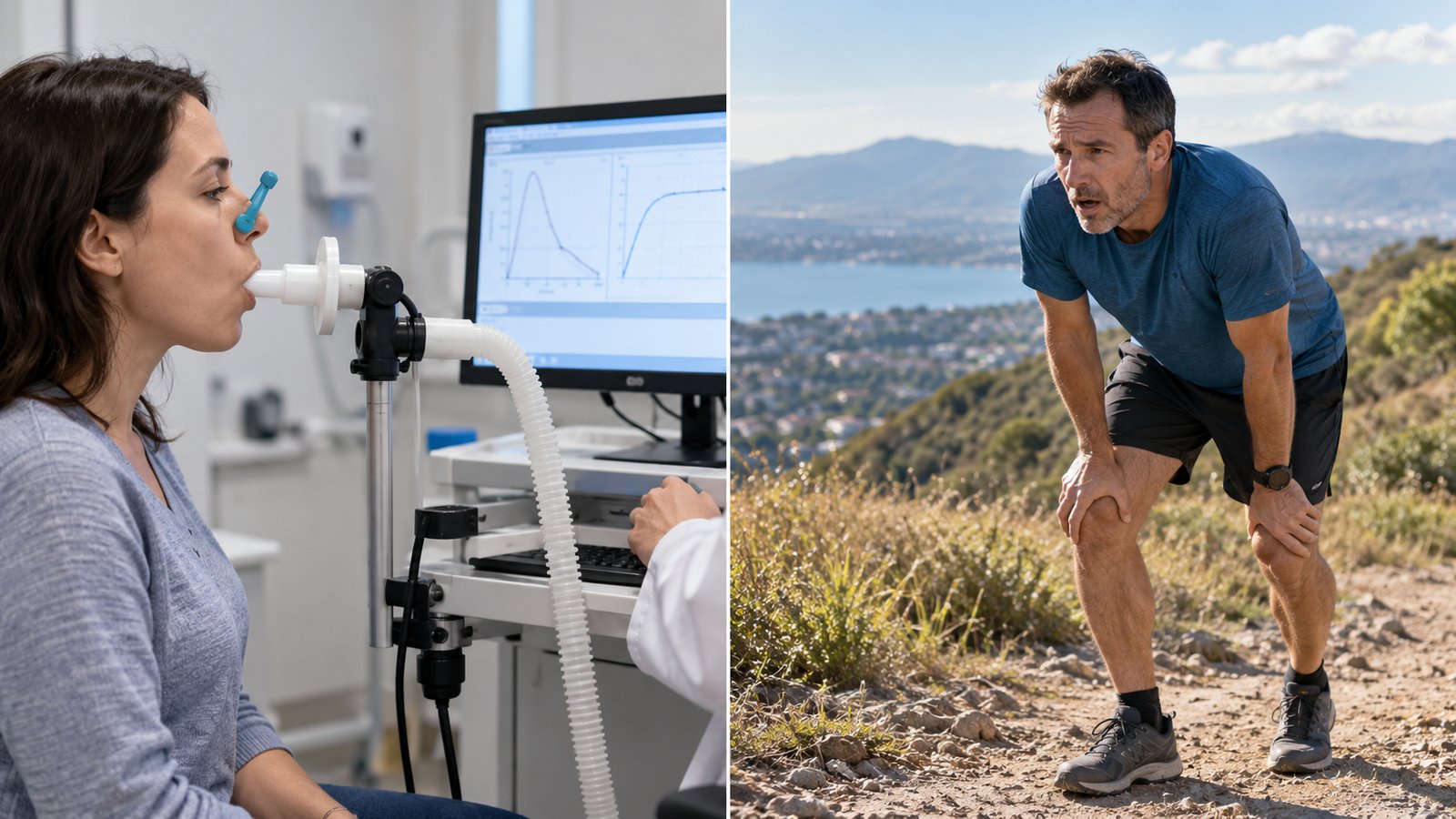
Spirometry measures how much air you can exhale and how quickly.
A bronchodilator test evaluates whether airflow improves after inhaling medication that relaxes the airways.
When routine spirometry is normal but asthma remains suspected, additional testing may be appropriate.
The takeaway: Normal oxygen levels - and even normal spirometry between episodes - do not necessarily exclude asthma.
3. Cause #2: COPD - When Air Gets Trapped Inside the Lungs
The clue: Progressive breathlessness during walking, climbing stairs, or other physical activity, sometimes accompanied by chronic cough.
Chronic obstructive pulmonary disease (COPD) causes persistent airflow limitation.
In many patients, especially those with emphysema, the problem is not simply getting air into the lungs.
It is getting air out.
When exhalation becomes difficult, some air remains trapped in the lungs.
During exercise, breathing becomes faster, leaving less time for complete exhalation.
The lungs may become progressively overinflated, a phenomenon called dynamic hyperinflation.
As lung volume increases, the diaphragm works at a mechanical disadvantage.
Breathing becomes increasingly uncomfortable.
Yet oxygen saturation may still remain normal, particularly in mild or moderate disease.
How we investigate it:
Pulmonary function testing can measure airflow limitation, lung volumes, and gas-transfer capacity.
Post-bronchodilator spirometry is essential for establishing the diagnosis of COPD.
Clinical pearl: In COPD, breathlessness is frequently driven by abnormal respiratory mechanics and dynamic hyperinflation - not simply oxygen deficiency.
4. Cause #3: Heart Disease - When the Problem Isn't in the Lungs
The clue: Breathlessness with exertion, reduced exercise tolerance, leg swelling, or difficulty breathing when lying flat.
The heart and lungs function as an interconnected system.
Even when the lungs are capable of oxygenating blood normally, inadequate cardiac performance can limit oxygen delivery to tissues or increase pressure in the pulmonary circulation.
Heart failure is one important example.
Some patients develop heart failure despite having a normal left ventricular ejection fraction, a condition called heart failure with preserved ejection fraction (HFpEF).
During physical activity, pressure inside the heart may rise abnormally.
This can increase pressure in the pulmonary circulation and produce breathlessness.
Oxygen saturation may remain normal at rest.
Other cardiac conditions, including coronary artery disease and certain arrhythmias, may also produce exertional dyspnea.
How we investigate it:
Depending on the patient's history and examination, evaluation may include:
-
Electrocardiogram (ECG)
-
Echocardiography
-
BNP or NT-proBNP blood testing
-
Additional cardiac investigations when indicated
The takeaway: When breathing becomes difficult during exercise, the heart deserves attention - even when oxygen levels and basic lung examinations appear normal.
5. Cause #4: Anemia - When Your Blood Carries Too Little Oxygen
The surprising truth: You can have a normal oxygen saturation but still deliver insufficient oxygen to your tissues.
To understand this, we need to distinguish oxygen saturation from oxygen content.
Oxygen saturation tells us the percentage of hemoglobin molecules carrying oxygen.
But the total amount of oxygen your blood can transport depends heavily on how much hemoglobin is present.
Imagine two buses.
Both are 98% full.
But one bus has 50 seats and the other has only 20.
They have nearly identical occupancy percentages, yet carry very different numbers of passengers.
Hemoglobin works similarly.
A patient with severe anemia may have an oxygen saturation of 98% but substantially reduced oxygen-carrying capacity.
During exercise, this limitation can produce fatigue, palpitations, and shortness of breath.
How we investigate it:
A complete blood count (CBC) can identify anemia.
Additional testing may be needed to determine whether the cause is iron deficiency, blood loss, nutritional deficiency, chronic disease, or another condition.
Clinical pearl: Normal oxygen saturation does not guarantee adequate oxygen delivery.
6. Cause #5: Obesity and Physical Deconditioning - When Breathing Becomes More Demanding
The clue: Breathlessness during everyday activities, particularly walking uphill, climbing stairs, or carrying groceries.
Obesity can change respiratory mechanics in several ways.
Excess abdominal and chest wall mass increases the mechanical load on breathing.
Lung volumes may decrease, especially functional residual capacity and expiratory reserve volume.
The diaphragm may have to work harder.
At the same time, moving a larger body requires more energy and ventilation.
Physical deconditioning creates a related problem.
When skeletal muscles become less efficient after prolonged inactivity, even ordinary physical activities require a greater relative effort.
Breathing becomes faster, and the sensation of respiratory discomfort increases.
These factors can coexist, making everyday activity feel unusually difficult.
An important caution: Never assume that breathlessness is caused solely by obesity or poor fitness.
Patients with obesity can also have asthma, heart failure, pulmonary vascular disease, anemia, or other treatable disorders.
How we investigate it:
A clinical assessment, pulmonary function tests, basic laboratory studies, and selected cardiac testing may help identify contributing mechanisms.
When routine testing is unrevealing, cardiopulmonary exercise testing (CPET) can sometimes distinguish respiratory, cardiovascular, and deconditioning-related limitations.
7. What About Anxiety and Dysfunctional Breathing?
The important distinction: Anxiety can contribute to breathlessness, but breathlessness should not automatically be attributed to anxiety when oxygen levels are normal.
The brain plays an essential role in perceiving breathing discomfort.
Stress and anxiety can alter breathing patterns, increase respiratory rate, and amplify awareness of respiratory sensations.
Some individuals develop dysfunctional breathing patterns, including excessive upper-chest breathing or episodes of overbreathing.
These can produce a distressing sensation of air hunger despite normal oxygenation.
However, cardiac, pulmonary, and metabolic conditions may cause similar symptoms.
The takeaway: Anxiety may be part of the explanation, but it should not become a substitute for an appropriate medical evaluation.
8. Can a Normal Oxygen Reading Miss Something Serious?
Yes. And this is particularly important.
A pulse oximeter is useful, but it has limitations.
It cannot detect every problem that interferes with breathing or oxygen delivery.
For example:
-
Pulmonary embolism: A blood clot in the lungs may cause sudden breathlessness even when oxygen saturation is normal.
-
Carbon dioxide retention: Some patients with hypoventilation can have elevated carbon dioxide despite an apparently acceptable oxygen reading, particularly when receiving supplemental oxygen.
-
Early or intermittent disease: Oxygen levels may be normal at rest but fall with physical activity or during sleep.
-
Measurement error: Poor circulation, movement, nail products, and skin pigmentation can influence pulse oximeter accuracy.
The FDA specifically advises patients not to rely exclusively on pulse oximeter readings when evaluating symptoms.
When to seek emergency care
Seek immediate medical attention for sudden or severe unexplained shortness of breath, particularly when accompanied by chest pain, fainting, confusion, blue discoloration, coughing blood, or marked difficulty speaking or breathing.
Do not delay emergency evaluation because your oxygen saturation appears normal.
9. How Do We Find the Real Cause of Your Shortness of Breath?
The solution: Measure more than oxygen.
A careful evaluation begins with understanding when breathlessness occurs.
Does it happen at rest or only during exercise?
Is it sudden or progressive?
Does it accompany wheezing, chest pressure, palpitations, swelling, or fatigue?
Your physician may recommend several tests depending on the clinical presentation.
TestWhat it helps evaluateSpirometryAirflow limitation and possible asthma or COPDComplete pulmonary function testsLung volumes, obstruction, restriction, and gas transferComplete blood countAnemiaChest imagingStructural lung abnormalitiesEchocardiographyCardiac structure and functionExercise oximetryOxygen saturation during exertionCardiopulmonary exercise testingIntegrated heart, lung, and muscle response to exercise
Not every patient needs every test.
The goal is to select investigations based on symptoms, examination findings, risk factors, and initial results.
In patients with persistent unexplained exertional dyspnea, CPET can provide particularly valuable physiological information.
By measuring oxygen consumption, carbon dioxide production, ventilation, and cardiovascular responses during exercise, CPET helps identify which physiological system is limiting activity.
Clinical pearl: The best diagnostic test is the one that answers the specific physiological question raised by the patient's symptoms.
The Pearl
Normal oxygen does not necessarily mean normal lungs, normal heart function, or normal breathing effort.
Shortness of breath is a symptom generated by the interaction of multiple physiological systems.
A pulse oximeter provides one useful measurement - but it cannot tell the whole story.
If you're short of breath, the important question is not only “What is my oxygen level?” but “Why is breathing difficult?”
Finding that answer is the first step toward effective treatment.
About Auria Medical Clinics
At Auria Medical Clinics, we approach breathlessness by investigating its underlying mechanisms rather than focusing on oxygen saturation alone.
Our integrated expertise in Pulmonary Medicine, Internal Medicine, Sleep Medicine, and Obesity Medicine allows us to evaluate respiratory symptoms in the context of overall health.
Services include pulmonary consultations, pulmonary function testing, evaluation of asthma and COPD, and assessment of breathing difficulties related to obesity and sleep-disordered breathing.
Are you experiencing shortness of breath despite normal oxygen readings?
A comprehensive evaluation may help uncover the reason and identify appropriate treatment.
Visit Auria Medical Clinics to learn about our services or request an appointment.
Auria Medical Clinics - Suwanee, Georgia.
References and Further Reading
-
Parshall MB, et al. An Official American Thoracic Society Statement: Update on the Mechanisms, Assessment, and Management of Dyspnea. Am J Respir Crit Care Med. 2012;185:435–452. Read the ATS statement.
-
U.S. Food and Drug Administration. Pulse Oximeters: Limitations and Appropriate Use. FDA guidance.
-
U.S. Food and Drug Administration. Pulse Oximeter Basics: Understanding Your Oxygen Reading. Read FDA recommendations.
-
Global Initiative for Chronic Obstructive Lung Disease (GOLD). Global Strategy for the Diagnosis, Management, and Prevention of COPD. GOLD reports.
-
Global Initiative for Asthma (GINA). Global Strategy for Asthma Management and Prevention. GINA reports.
Medical disclaimer: This article is intended for general educational purposes and should not replace individualized medical evaluation. Sudden, severe, or rapidly worsening breathlessness requires urgent medical attention.