

How to regulate your fat as an organ
5 Surprising Truths Your Body Fat Wants You to Know
Revealing the Real Role of Fat: From Misunderstood Villain
to Essential Organ
Body fat—it’s the one thing most of us wish we could simply
wash away. For decades, fat has been cast as the villain in every health story,
the silent saboteur lurking beneath our skin, responsible for everything from
expanding waistlines to chronic disease. Bathroom scales, diet plans, and
fitness fads all point to one goal: less fat. But what if we’ve gotten it all
wrong? What if, instead of being a lazy, inert burden, our body fat is a
brilliant, hard-working organ that’s critical to our well-being?
Emerging science has flipped our understanding of fat on its
head. Far from being just dead weight, fat is now recognized as a dynamic,
communicative, and essential part of our body—one that plays a starring role in
health, immunity, mood, and even survival. In this article, we’ll explore five
surprising truths about body fat that are reshaping how we think about our
bodies and our approach to health.
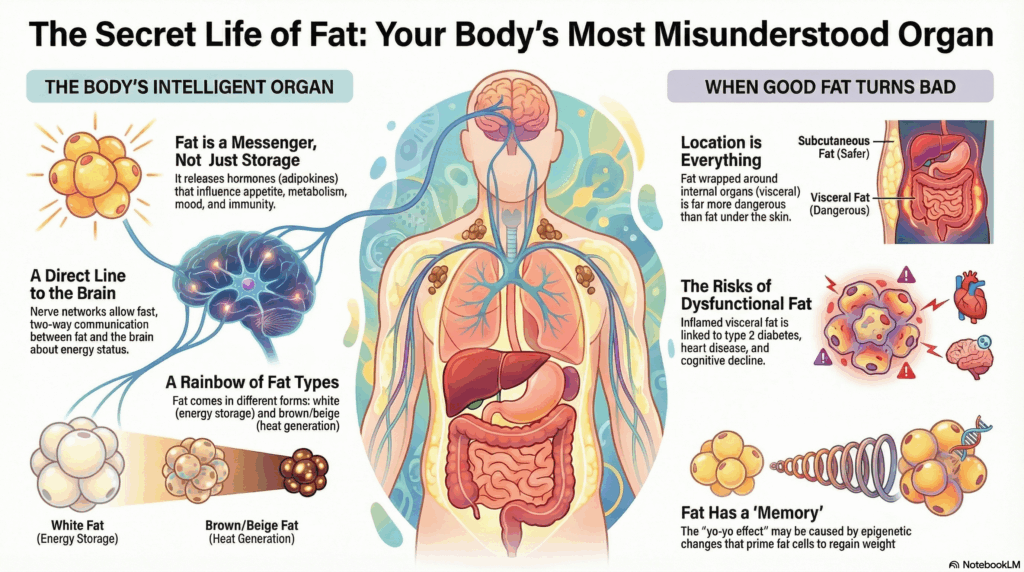
1. Fat Is Not Just Storage—It’s a Highly Communicative Organ
The old story told us that fat merely stores extra calories,
waiting for the next famine to strike. But today’s research paints a much more
fascinating picture. Scientists now classify body fat, or adipose tissue, as a
full-fledged organ, just like the liver or lungs. It is not just a passive
repository—it’s an active player in a continuous conversation with the rest of
your body.
How does fat “talk� There are two main channels.
Chemically, fat cells release dozens of hormones and signaling molecules,
called adipokines. Leptin, for example, is famous for telling your brain when
you’re full, regulating hunger and energy. Electrically, new discoveries have
revealed a network of nerve fibers extending into fat, allowing rapid, two-way
communication with the brain. This means fat can report on its own
condition—whether it’s healthy, inflamed, or injured—and receive commands in
real time. This shift in understanding reframes fat not as a problem,
but as a vital, intelligent organ that helps orchestrate our body’s daily functions.
2. Fat Has Many Jobs—It’s a Multi-Talented Organ
Think of fat as your body’s Swiss Army knife. While energy storage is its most famous role, fat is involved in a remarkable variety of bodily functions, often working quietly behind the scenes.
• Immunity: Fat is an immune command center. It houses nearly every type of immune cell, helping to coordinate inflammation and the body’s response to infection.
• Mood: Research shows that when fat tissue becomes unhealthy and inflamed, it can spark inflammation in the brain. This process may contribute to mood disorders like depression and anxiety, establishing a direct link between fat health and mental well-being.
• Fertility: A certain level of body fat is essential for reproductive health. Without enough fat, menstruation can stop altogether, as the body lacks the energy reserved to support pregnancy.
• Bone Health: Fat produces estrogen, a hormone crucial for maintaining strong bones. However, if fat becomes dysfunctional and chronically inflamed, it may harm bone quality.
In short, fat is a critical regulator of many systems, not just a calorie warehouse.
3. Location and Behavior Matter More Than Amount
Not all fat is created equal. The health impact of fat depends not just on how much you have, but where and how it’s stored. There are two main types of white fat: subcutaneous (just under the skin) and visceral (deep inside, around your organs).
It’s visceral fat that poses the greatest health risk. When these fat cells expand too much, their blood supply can’t keep up. Struggling and starved of oxygen, visceral fat releases inflammatory signals, attracting immune cells and triggering a cascade of harmful effects throughout the body. This process is tied to higher risks of type 2 diabetes, heart disease, and certain cancers.
Surprisingly, some people classified as obese—up to 30%—do not experience these health issues. The difference? Their fat is stored safely under the skin, and their fat cells remain smaller and less inflamed. This phenomenon, known as “metabolically healthy obesity,†shows that it’s not just the quantity of fat that matters, but its location and function.
4. Trying to Eliminate Fat Can Backfire
With all the focus on losing fat, it’s tempting to think that surgical removal—like liposuction—is a quick fix. But science tells a different story. Studies reveal that when fat is surgically removed from one area, the body often compensates by storing more fat elsewhere, sometimes in the more dangerous visceral depots.
Worse yet, removing the safer, subcutaneous fat can trigger the body to replace it with the harmful kind surrounding the organs. This means well-intentioned efforts to “spot-reduce†fat may increase your risk. The body’s drive to maintain its fat stores is powerful and difficult to override.
5. Fat Has a Memory—And It’s Stubborn
If you’ve ever lost weight only to regain it (the dreaded “yo-yo effectâ€), you’re not alone—and it’s not simply a matter of willpower. Scientists now believe that fat cells have a kind of “memory.†After weight loss, especially following obesity, fat cells retain chemical marks (epigenetic changes) that prime them to quickly regain fat if you return to a high-calorie diet.
From an evolutionary standpoint, this makes sense. Our ancestors who efficiently regained lost weight after periods of famine were more likely to survive. Today, however, it means that keeping weight off can be a tough battle, requiring more than just short-term changes.
Conclusion: Rethinking Our Relationship with Fat
Science is clear: fat is not our enemy. It’s a dynamic, essential organ that deserves respect and understanding, not contempt. Like a member of a symphony, fat plays an integral part in the harmonious functioning of our body. When it’s “in tune,†our health flourishes; when it’s not, problems arise.
Rather than asking how to get rid of fat, a better question might be: how can we keep our fat healthy? This means focusing on lifestyle choices—balanced nutrition, regular physical activity, stress management, and adequate sleep—that support the overall health of our fat, rather than simply trying to shrink it.
By shifting our perspective, we not only become kinder to ourselves but also set the stage for better, more sustainable health. It’s time to make peace with our most misunderstood organ—and embrace the vital role it plays in our lives.
Source: Geddes, Linda. “The Vital, Overlooked Role of Body Fat in Shaping Your Health and Mind.” New Scientist, November 17, 2025.